Behind Vienna’s Velvet Curtains: Forgotten Facades That Whisper History
Ever walked past a building and felt it was watching you? In Vienna, I did—over and over. Beyond the glitter of palaces and coffee houses, the city hides architectural secrets in plain sight. Crumbling stucco, hidden courtyards, art nouveau whispers… these details aren’t just decoration. They’re stories frozen in stone. And honestly? Most tourists miss them completely. Let me show you the Vienna architects dream about—but rarely talk about. This is not the Vienna of imperial processions or symphony halls. This is the city beneath the surface, where every chipped cornice and shadowed archway holds a quiet truth about how people lived, loved, and built lives across centuries. To see it, you must slow down, look closer, and listen not with your ears, but with your eyes.
The Unseen Face of Vienna: Looking Past the Postcard
Vienna’s image in the global imagination is polished to a high sheen: golden domes glittering above cobbled squares, horse-drawn carriages rolling past Baroque facades, and the scent of freshly ground coffee drifting from century-old cafés. These are real, and they are magnificent—but they are also carefully curated. They represent the city’s public face, the version of Vienna that fits neatly on a postcard or within a two-hour guided tour. What lies beyond this curated perfection is something more intimate, more enduring: the city’s architectural soul, revealed not in grand gestures but in subtle imperfections.
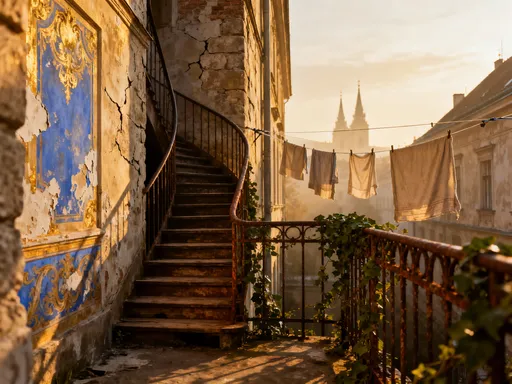
Walk just one block off the Ringstraße, and the narrative begins to shift. Here, the plaster on a 19th-century tenement peels in delicate curls, exposing layers of paint from different eras—ochre, sage, dusty rose—like the rings of a tree. A wrought-iron gate, half-rusted, bears the faint imprint of a family crest long forgotten. A row of mismatched roof tiles suggests decades of careful, piecemeal repair rather than grand restoration. These are not flaws. They are evidence. They tell of resilience, of continuity, of a city that has lived through empires, wars, and waves of change without losing its quiet dignity.
Why do these details matter? Because they anchor us in reality. While grand monuments celebrate power and prestige, these overlooked elements reflect daily life—the lives of artisans, shopkeepers, teachers, and mothers who raised children behind these walls. They remind us that history is not only made in palaces but in hallways, stairwells, and backyard gardens. To notice them is to practice a different kind of tourism: one rooted in attention, respect, and emotional connection. It is not about collecting sights, but about cultivating awareness. And in Vienna, where beauty is often expected, the real magic lies in the unexpected—the crooked doorframe, the window with a single cracked pane, the balcony with a single potted geranium surviving against the odds.
Courtyards of Silence: The Hidden Worlds Behind Unmarked Doors
One of Vienna’s best-kept secrets requires no ticket, no reservation, and no special access—only the courage to push open an unmarked door. Scattered throughout the Innere Stadt and neighboring districts, these portals lead into a network of inner courtyards known locally as Höfe. Often invisible from the street, they unfold like Russian nesting dolls: one courtyard after another, sometimes three or four deep, each revealing a different era, a different mood, a different way of living.
Some of these spaces are grand, remnants of aristocratic estates where frescoed ceilings still show traces of cherubs and grapevines. Others are humble, surrounded by weathered brick and iron railings blackened by time. In many, life continues quietly. Laundry flutters between buildings like prayer flags. Bicycles lean against walls, their tires slowly deflating. A cat naps on a sun-warmed windowsill. An old man waters flowers in a cracked ceramic pot. These are not staged scenes for tourists; they are ordinary moments, unfolding in extraordinary settings.
Architecturally, the Höfe reflect centuries of adaptation. A Baroque fountain might sit beside a 1950s concrete staircase. A Gothic arch frames a neon-lit convenience store. These contrasts are not accidents—they are testaments to a city that values continuity over erasure. Unlike other European capitals that have bulldozed their historic cores for modern development, Vienna has chosen to layer its history, allowing old and new to coexist in a kind of quiet dialogue. The courtyards, once the social hearts of multi-family dwellings, still serve as informal gathering places, where neighbors exchange greetings and children play hopscotch on stone tiles worn smooth by generations of footsteps.
To walk through these spaces is to experience time in three dimensions. The air feels different—cooler, quieter, insulated from the bustle of the street. The light falls in unexpected patterns, filtered through iron balconies and climbing ivy. And the silence is not empty; it is full of memory. These courtyards are not museums. They are living spaces, preserved not for display but because they still serve a purpose. In a world increasingly dominated by glass towers and sterile plazas, they offer a rare model of urban life: dense, human-scaled, and deeply rooted in place.
Art Nouveau Ghosts: Where Jugendstil Still Breathes
If Vienna has a secret aesthetic heartbeat, it belongs to Jugendstil—the Austrian variant of Art Nouveau that flourished in the early 20th century. While the city proudly showcases the Secession Building with its golden cabbage dome, far more subtle examples of the style linger in residential neighborhoods, often unnoticed by passersby. These are not monuments, but homes—modest apartment buildings with floral ironwork, sinuous stonework, and mosaics in soft pastels that seem to blush in the morning light.
Jugendstil was more than a design movement; it was a philosophy. Its proponents, including Otto Wagner, Josef Hoffmann, and Koloman Moser, believed that beauty should not be reserved for the elite. Art should be integrated into everyday life—into door handles, stair rails, and floor tiles. Form should follow function, but function could still be graceful. The movement emerged during a time of great social and cultural change, a brief window when optimism about progress was matched by a reverence for craftsmanship. These buildings, scattered across districts like Wieden and Margareten, are physical manifestations of that idealistic moment.
To recognize them, look for certain signatures. The whiplash curve—a sharp, dynamic S-shape—appears in wrought-iron railings and stone carvings, suggesting movement even in stillness. Floral motifs are stylized rather than realistic: roses with elongated petals, vines that twist like smoke. Doorways are often framed with symbolic elements—a peacock for beauty, a sunburst for enlightenment. Even the colors speak a quiet language: sage green, dusty lilac, cream—soft tones that contrast with the boldness of later modernism.
Many of these buildings are still private residences, their beauty preserved not for tourism but out of local pride. Some have been carefully restored; others show the gentle wear of time. What unites them is a sense of intentionality. Nothing feels arbitrary. Every detail, from the shape of a window latch to the pattern of a floor mosaic, was considered. To walk past one is to witness a commitment to dignity in the everyday—a belief that how we build our homes reflects how we value our lives. In an age of mass production and disposable design, these quiet facades stand as quiet rebels, whispering that beauty matters, even when no one is looking.
The Geometry of Gentrification: Old Meets New in Marginal Districts
Travel far enough from Vienna’s historic core, and a different kind of architectural conversation emerges—one shaped by tension, compromise, and cautious innovation. In districts like Favoriten, Meidling, and Ottakring, the city’s past and future collide in ways that are both jarring and inspiring. Here, 19th-century tenements with faded stucco and sagging cornices stand shoulder to shoulder with bold contemporary interventions: glass boxes perched on rooftops, translucent panels inserted into brick walls, and angular stairwells that seem to float above courtyards.
This is not random development. It is part of a deliberate urban strategy. Vienna has long prioritized social housing, and in recent decades, city planners have faced the challenge of modernizing aging buildings without erasing their character. The solution? Adaptive reuse. Instead of demolishing old structures, architects are reinterpreting them—adding modern elements that contrast with, rather than imitate, the original fabric. A new extension might be made of frosted glass, allowing light to filter through while maintaining privacy. A rooftop addition could take the form of a geometric cube, its clean lines highlighting, rather than hiding, the irregularity of the old roofline.
These projects are not without controversy. Some residents worry that modernization leads to gentrification, pushing out long-time tenants in favor of higher-income newcomers. Others welcome the improvements—better insulation, updated plumbing, accessible entrances—that make older buildings livable for future generations. The city has responded with policies that protect rent-controlled apartments and require a percentage of new units to remain affordable. As a result, the transformation is gradual, layered, and socially conscious.
For the observant traveler, these neighborhoods offer a rare opportunity to witness urban evolution in real time. Walking along a street in Meidling, you might see three versions of the same building: one in its original state, one partially renovated with a glass courtyard insert, and one fully transformed with a modern façade that still respects the original window rhythm. This dialogue between old and new is not always harmonious, but it is honest. It reflects a city that honors its past without being trapped by it, that embraces progress without sacrificing equity. In a world where cities often choose between preservation and development, Vienna is quietly proving that both are possible.
Forgotten Arches and Phantom Balconies: Architectural Illusions and Oddities
One of the most delightful aspects of Vienna’s architecture is its sense of playfulness. Beneath the city’s dignified surface runs a current of whimsy, expressed in subtle architectural tricks that blur the line between reality and illusion. Look closely, and you’ll find fake windows painted on blank walls, columns that exist only as flat reliefs, and balconies with sealed doors—phantom features that serve no functional purpose but add rhythm, symmetry, or charm to a streetscape.
Some of these illusions have practical origins. In the 18th and 19th centuries, window taxes were common across Europe. To avoid higher assessments, building owners would brick up windows or paint false ones to maintain a uniform façade. In Vienna, where aesthetic harmony was highly valued, this practice persisted even after the taxes were abolished. A symmetrical façade was considered more beautiful, more respectable—worth preserving even at the cost of natural light.
Other oddities are pure whimsy. The Viennese have a cultural tradition known as Schmäh—a kind of affectionate, ironic humor that values cleverness over seriousness. This spirit finds expression in architecture. A building might have a door that opens onto a solid wall, a staircase that leads to nowhere, or a sculpted gnome tucked into a corner where only the most observant will spot it. These are not mistakes. They are inside jokes, shared between architect and city.
One famous example is the Haus am Michaelerplatz, where part of the original medieval structure was preserved behind a Baroque façade, creating a layered effect that confounds the eye. Another is the so-called “blind windows” on buildings in the 3rd district, where painted panes mimic real ones so convincingly that tourists often try to look inside. These features do not shout for attention. They wait. They reward patience. They invite the viewer to question what is real, what is remembered, and what is imagined. In a city so rich in history, even deception can feel like a form of honesty—a reminder that appearances are never simple, and that beauty often lies in the details we overlook.
Tools for Slow Seeing: How to Train Your Eye Like a Local
You don’t need an architecture degree to appreciate these subtleties. What you need is time, attention, and a willingness to see differently. The good news? These skills can be learned. The practice of “slow seeing” is not about memorizing styles or identifying architects. It is about cultivating a habit of observation—of noticing not just what is there, but what is missing, what has changed, what endures.
Start with pace. Walk slowly. Not the brisk stride of a tourist racing to the next landmark, but a meandering, unhurried gait. Allow your eyes to drift upward, sideways, downward. Look at the base of buildings—their thresholds, their foundations, the way water has stained the stone. Look at transitions—where one material meets another, where old brick meets new mortar. These edges often tell the most honest stories.
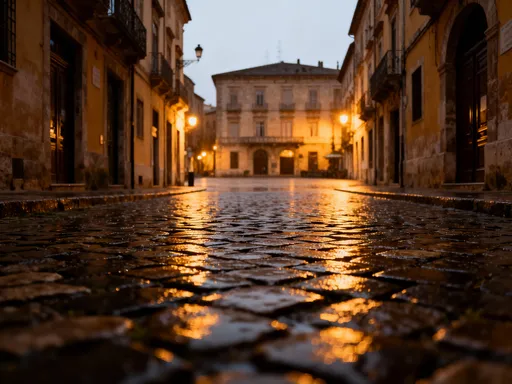
Pay attention to light. Morning light casts long shadows that emphasize texture—peeling paint, carved stone, rusted iron. Afternoon sun flattens surfaces, making colors more vivid. Evening light, especially under streetlamps, creates mystery, turning ordinary facades into silhouettes. The same building can feel like a different place at different times of day.
Adopt the “three-second rule.” Pause in front of every building, even for just three seconds. Ask yourself: What catches my eye? Is it the color? The shape of a window? A crack in the plaster? A flower box? You don’t need to know the answer—just the act of looking changes your relationship to the city. Over time, patterns emerge. You begin to recognize recurring motifs, construction techniques, and historical layers.
Think of it like birdwatching. At first, all birds look the same. But with practice, you learn to distinguish a sparrow from a finch by the curve of its beak, the pattern of its feathers. So too with architecture. At first, all old buildings look similar. But soon, you notice the difference between a late Baroque cornice and a Historicism revival piece. You see how a Jugendstil balcony differs from a Neo-Renaissance one. You start to read the city like a text, each building a sentence, each street a paragraph in a larger story. And the best part? No apps, no headphones, no gadgets are required. Just your eyes, your curiosity, and a little patience.
Why These Details Define Vienna’s Soul—And How to Honor Them
In the end, Vienna’s greatness does not reside solely in its museums, concert halls, or imperial palaces—though these are undeniably magnificent. Its true soul lives in the quiet details: the hand-carved leaf on a forgotten doorway, the courtyard where a grandmother hangs her laundry, the painted window that winks at the past. These are not embellishments. They are the city’s memory, written in stone, brick, and iron.
What makes Vienna unique is not just its history, but its relationship to that history. The city does not treat the past as a costume to be worn on special occasions. It lives with it, breathes with it, builds upon it. There is a deep cultural respect for continuity, for craftsmanship, for the idea that beauty and function can coexist. This is a city that repairs rather than replaces, that values the patina of time, that understands that perfection is not the same as authenticity.
To honor these details, we do not need to restore them, photograph them, or even point them out. We honor them by noticing. By pausing. By choosing not to rush past. When we take the time to see the in-between spaces—the alleyways, the side streets, the unmarked doors—we participate in an act of quiet reverence. We become, in a small way, stewards of memory.
And perhaps, in learning to see Vienna this way, we learn to see our own cities differently. We begin to notice the stories embedded in our own neighborhoods—the cracked steps, the mismatched bricks, the windows with crooked shutters. We realize that every city has a hidden layer, if only we are willing to look.
So the next time you walk through Vienna, don’t just visit the landmarks. Wander. Get lost. Look up, look down, look again. Let the buildings speak. Listen not for grand declarations, but for whispers. Because in those quiet moments, when you stand before a crumbling façade or a hidden courtyard, you are not just seeing a city. You are remembering what it means to be human—to build, to endure, to leave a mark, however small, on the world.