Why Ayutthaya’s Public Spaces Tell Thailand’s Soul Story
You know what hit me in Ayutthaya? It wasn’t just the temples—it was how people live among them. This ancient city isn’t a museum; it’s a living, breathing community where history and daily life blend seamlessly. From monks walking through public parks to locals chatting by centuries-old ruins, every shared space feels sacred. I never expected culture to be so visible in the streets, markets, and riverbanks. Ayutthaya’s public spaces aren’t just places—they’re stories written in stone, spirit, and everyday moments.
The Living Heritage of Ayutthaya
Ayutthaya stands as a rare example of a UNESCO World Heritage site that has not been sealed off behind velvet ropes or elevated on a pedestal of untouchable preservation. Instead, it pulses with the rhythm of ordinary life. Designated in 1991 for its outstanding cultural and historical significance, the city remains deeply embedded in the daily routines of its residents. Unlike archaeological sites that exist solely for observation, Ayutthaya’s public spaces are actively used, inhabited, and cared for by the local population. The ruins of palaces and monasteries are not relics isolated from society—they are part of it. Children ride bicycles past crumbling prangs, vendors set up near ancient causeways, and elders pray beneath shaded stupas. This integration ensures that the city's heritage is not frozen in time but continues to evolve through lived experience.
What makes Ayutthaya exceptional is the balance it maintains between conservation and community. While many heritage sites face the challenge of becoming either tourist spectacles or abandoned relics, Ayutthaya thrives because it belongs to the people. Local families often live within walking distance of temple complexes, and their presence helps safeguard the authenticity of the environment. Traditional practices such as morning almsgiving, merit-making ceremonies, and seasonal festivals are not performed for visitors—they are integral to daily life. This continuity ensures that cultural transmission happens organically, from generation to generation, without relying on formal education or curated exhibitions. The city becomes a living classroom where history is absorbed through participation rather than passive viewing.
Moreover, this model offers valuable lessons for sustainable cultural tourism. When heritage is shared rather than staged, it fosters deeper respect from visitors. Tourists witness not reconstructed traditions but real ones—unscripted, unpolished, and profoundly human. Authorities have recognized the importance of this balance, implementing zoning regulations that limit high-rise developments and commercial encroachments near historic zones. At the same time, infrastructure improvements like pedestrian pathways and signage aim to enhance accessibility without compromising the site’s integrity. The goal is not to turn Ayutthaya into a theme park of antiquity, but to allow it to remain what it has always been: a home, a sanctuary, and a testament to resilience.
Temples as Social Hubs, Not Just Monuments
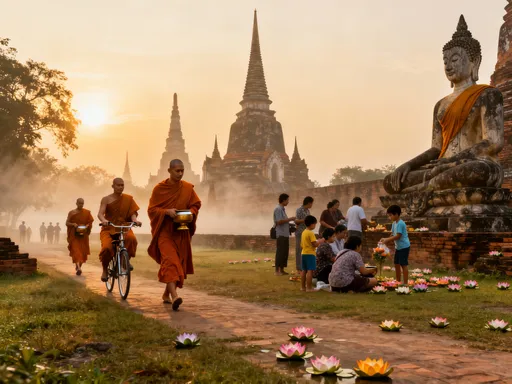
In Ayutthaya, temples function far beyond their architectural grandeur—they are centers of social gravity. Places like Wat Mahathat and Wat Phra Si Sanphet are not silent monuments frozen in reverence, but dynamic public arenas where spiritual practice and communal life intersect. At dawn, the air fills with the soft chime of bells as saffron-robed monks walk barefoot along stone pathways, receiving alms from waiting devotees. Elderly women kneel on woven mats, placing offerings of rice, fruit, and incense at the base of weathered Buddha images. These acts are not performances; they are rituals woven into the fabric of daily existence, sustained by generations who see no separation between sacred space and everyday life.
By mid-morning, the temples take on a different character. Families stroll through shaded cloisters, pointing out intricate carvings to wide-eyed children. Teenagers gather near lotus ponds to take photos, while local artists set up easels to sketch the silhouette of a broken chedi against the sky. Monks cycle through temple grounds, returning from errands or heading to study sessions, their presence both serene and ordinary. The accessibility of these spaces is remarkable—there are no velvet barriers or timed entry tickets restricting movement. Visitors walk freely among worshippers, and locals treat tourists with quiet courtesy, neither shunning them nor performing for them. This openness reinforces the idea that spirituality in Thailand is not confined to private devotion but thrives in shared environments.
The layout of these temple complexes also encourages interaction. Open courtyards, covered walkways, and shaded pavilions provide natural gathering points. During festivals such as Visakha Bucha, thousands gather to circumambulate the main prang, lighting candles and chanting in unison. Even outside religious events, the temples serve as informal meeting places—elders chat on benches, students review lessons under banyan trees, and neighbors catch up after morning markets. This social vitality ensures that the temples remain relevant, not just as symbols of the past, but as active contributors to community well-being. Their endurance is not only due to stone and mortar, but to the continuous flow of human connection they nurture.
Riverbanks and Bridges: The Pulse of Community Life
The rivers of Ayutthaya—the Chao Phraya and the Pasak—are not merely geographical features; they are lifelines that shape the rhythm of community life. Historically, these waterways served as transportation arteries during the kingdom’s golden age, linking the island city to distant provinces and foreign traders. Today, they remain central to daily routines, offering space for recreation, livelihood, and quiet contemplation. Along the riverbanks, life unfolds in a series of small, meaningful moments: a fisherman casts his net at sunrise, a mother washes clothes on the steps of an old ghat, children splash in shallow waters after school. These scenes are not curated for tourists—they are glimpses into a way of life that has persisted for centuries.
Footbridges and riverside paths further enhance connectivity, encouraging slow, intentional movement through the city. Unlike highways or motorized transit, these pedestrian-friendly routes invite lingering and interaction. Locals pause to watch boats glide by, vendors call out from floating stalls, and couples sit together on stone ledges as the sun dips below the horizon. The pace is unhurried, allowing space for spontaneous conversations and shared silences. This emphasis on walkability fosters a sense of ownership over public space—residents do not merely pass through these areas; they inhabit them. The design of the riverfront, with its low walls, shaded benches, and open access points, reflects a deep understanding of how people naturally gather and connect.
Seasonal changes also influence how the rivers are used. During the rainy season, when water levels rise, some pathways flood, temporarily altering access routes. Yet rather than being seen as disruptions, these shifts are accepted as part of nature’s cycle. Communities adapt, using small boats to navigate flooded alleys or relocating market stalls to higher ground. This resilience speaks to a broader cultural attitude—one that embraces impermanence and coexists with the environment rather than seeking to control it. Even in modern times, when concrete embankments and drainage systems have been introduced, traditional knowledge remains vital. Elders still read the river’s behavior through subtle signs—changes in current, bird movements, or plant growth—passing this wisdom down to younger generations.
Markets as Cultural Crossroads
If temples are the spiritual heart of Ayutthaya, its markets are the social lungs—breathing in diversity, energy, and tradition. Warorot Market and the floating vendors along Bang Ian Canal are not merely places to buy goods; they are vibrant ecosystems of exchange where language, flavor, and custom converge. The sensory experience is immediate and immersive: the sizzle of *pad kra pao* in hot woks, the sharp tang of tamarind, the rhythmic clang of pestles pounding curry paste in stone mortars. Vendors call out prices in a melodic cadence, bargaining unfolds with smiles and laughter, and the air carries the mingled scent of ripe mango, grilled fish, and fresh coconut. This is commerce, yes—but it is also culture in motion.
What distinguishes these markets from modern shopping centers is their emphasis on human connection. Stalls are often family-run, some operating for decades, with recipes and techniques passed down through generations. A woman selling *khanom buang*—crispy Thai pancakes—might be using the same iron griddle her grandmother once did. Her hands move with practiced ease, folding delicate shells filled with sweet coconut and egg yolk. Customers aren’t just buyers; they’re regulars, neighbors, sometimes friends. Conversations flow easily, stories are shared, and news travels as quickly as the next dish is served. This intimacy fosters trust and continuity, ensuring that artisanal skills do not vanish in the face of mass production.
The physical layout of the markets also promotes interaction. Narrow lanes encourage close proximity, forcing people to slow down and engage. Unlike the sterile efficiency of supermarkets, where movement is linear and transactional, Ayutthaya’s markets are designed for lingering. Shoppers weave through clusters of vendors, sampling as they go, pausing to watch a vendor prepare *som tam* or listening to an elder recount the history of a particular spice blend. These moments of unplanned exchange are where culture is truly preserved—not in textbooks, but in the living memory of those who practice it daily. For visitors, the market is not just a place to eat or shop, but to witness the pulse of community life in its most authentic form.
Parks and Urban Green Spaces: Where History Meets Leisure
In Ayutthaya, the boundary between historical preservation and everyday recreation is beautifully blurred. City parks such as Ayutthaya Historical Park and Khlong Suan Phrik are not manicured lawns set apart from the past, but integrated landscapes where ancient ruins coexist with modern life. Joggers loop around the bases of 14th-century prangs, students spread textbooks beneath sprawling banyan trees, and families picnic beside collapsed viharns, their laughter echoing off weathered stone. There is no sense of sacrilege in these acts—instead, there is harmony. The ruins are not treated as fragile artifacts behind glass, but as enduring companions to daily life, their presence both grounding and inspiring.
This normalization of history within leisure spaces reflects a distinctly Thai worldview—one that embraces impermanence and sees beauty in decay. Unlike Western models of heritage conservation, which often prioritize restoration and permanence, Ayutthaya’s approach accepts the natural cycle of growth and erosion. Crumbling walls are not rebuilt to their original state; instead, they are stabilized and left to tell their story through their very weathering. This philosophy, rooted in Buddhist teachings on transience, allows residents to form emotional bonds with the past without romanticizing it. A broken Buddha head entwined in tree roots is not hidden away—it is acknowledged, respected, and allowed to remain as a testament to time’s passage.
These green spaces also serve as vital refuges in an increasingly urbanized world. As nearby cities expand and concrete spreads, Ayutthaya’s parks offer cool shade, fresh air, and open skies. They are democratic by nature—accessible to all, regardless of age, income, or background. Elderly couples take slow walks along tree-lined paths, teenagers fly kites near open fields, and monks meditate in quiet corners, undisturbed by the surrounding activity. The coexistence of stillness and motion within the same space is a quiet miracle, made possible by thoughtful design and cultural values that prioritize balance. In these parks, history is not studied—it is lived, breathed, and felt underfoot.
Festivals and Seasonal Use of Public Space
Throughout the year, Ayutthaya’s public spaces undergo magical transformations during festivals, turning streets, bridges, and temple grounds into stages for collective celebration. Loy Krathong, the Festival of Lights, is perhaps the most visually stunning of these events. As dusk falls, thousands gather along the Chao Phraya River, each carrying a handcrafted *krathong*—a floating offering made of banana leaves, flowers, candles, and incense. The water becomes a shimmering tapestry of light, reflecting the night sky as people release their offerings in silent prayer. Children giggle as their small rafts drift away, while elders bow their heads in quiet reflection. The entire city seems to pause, united in a moment of gratitude and release.
Songkran, the Thai New Year, brings a different kind of energy—one of joyous chaos and renewal. For three days each April, streets transform into water battlegrounds, as people of all ages splash, spray, and douse each other with buckets, hoses, and water pistols. What might appear as mere play is deeply symbolic: water washes away the misfortunes of the past year and brings blessings for the one ahead. Entire neighborhoods participate, setting up temporary stations with music, food, and shaded rest areas. Even monks join in the spirit, smiling as gentle sprays cool them during their morning walks. The festival temporarily redefines social norms—strangers become playmates, hierarchies dissolve, and public space becomes a realm of inclusive, intergenerational celebration.
These festivals reveal the deep connection between cultural identity and shared space. When temples host community altars, when bridges become viewing platforms for lantern releases, and when market squares fill with dance troupes and food stalls, the city itself becomes a living ritual. The temporary nature of these events only enhances their power—they are not permanent installations, but fleeting moments of unity that residents look forward to all year. They also reinforce the idea that public spaces are not just for utility, but for meaning. In a world where digital interaction often replaces face-to-face connection, Ayutthaya’s festivals remind us of the enduring value of gathering, celebrating, and remembering together.
Challenges and the Future of Shared Spaces
Despite its cultural richness, Ayutthaya faces growing pressures that threaten the delicate balance between tourism and community life. Visitor numbers have steadily increased over the past decade, drawn by the city’s UNESCO status and growing visibility in travel media. While tourism brings economic benefits—supporting local businesses, creating jobs, and funding preservation efforts—it also introduces challenges. Crowds can overwhelm narrow pathways, noise levels disrupt meditation and prayer, and commercial vendors sometimes encroach on historically sensitive areas. In some cases, residents report feeling like outsiders in their own neighborhoods, as certain zones become prioritized for tourist access over local use.
Infrastructure development adds another layer of complexity. Proposals for expanded parking lots, shuttle services, and new visitor centers aim to improve convenience, but they risk altering the city’s character. Wider roads may ease traffic, but they can also disrupt pedestrian flow and fragment green spaces. Similarly, while digital ticketing and timed entries might manage crowds, they could create barriers for locals who have traditionally accessed these spaces freely. The challenge lies in modernizing without alienating the very community that sustains Ayutthaya’s authenticity.
To address these concerns, local authorities and cultural organizations have begun implementing community-centered planning initiatives. Public consultations now involve residents in decisions about zoning, traffic management, and event scheduling. Pilot programs have introduced “quiet hours” at major temple sites, ensuring that early morning rituals remain undisturbed. Signage is being improved to educate visitors about respectful behavior, such as removing shoes before entering sacred areas and avoiding loud conversations near meditation zones. Additionally, efforts to promote off-peak visitation and distribute tourists across lesser-known sites help reduce pressure on core areas.
The ultimate goal is to ensure that Ayutthaya’s public spaces remain truly public—not just in name, but in function. This means prioritizing residents’ access, protecting cultural expression, and preserving the organic blend of history and daily life that defines the city. Sustainable tourism should not mean maximizing visitor numbers, but deepening the quality of engagement. When travelers come not to check a destination off a list, but to witness and participate in a living culture, the relationship becomes reciprocal. The city gives, and in return, it is respected, protected, and sustained.
Ayutthaya’s power lies not just in its past, but in how that past lives—breathed, touched, and reshaped every day in shared spaces. Its temples, markets, and riverbanks are more than attractions; they’re proof that culture thrives not behind glass, but in the open air of common life. To visit Ayutthaya is to witness heritage as a verb, not a noun. The real journey? Seeing how a city keeps its soul alive—one public moment at a time.